
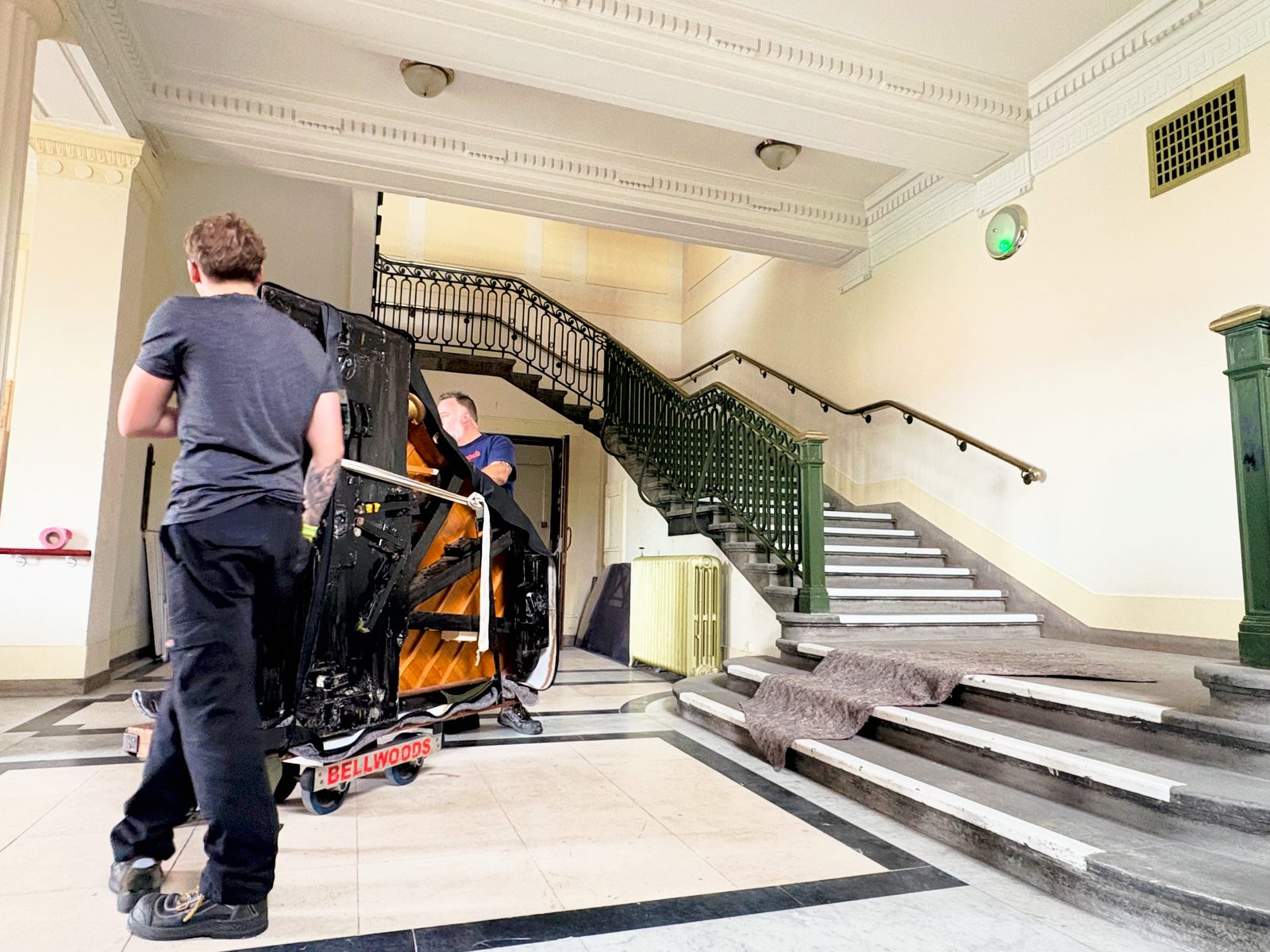
A Steinway Model A, five flights of a listed staircase, and a stage at the top of it. By the time this job reached us, two other removal companies had already looked at it and said no, and there was a concert in the diary for 25 September that was about to be cancelled.
The enquiry came in to our sister company Piano Logistics Manchester and was passed straight across to Bellwoods, because of what the move actually involved. Here is how it went.
The job: entrance level to the stage
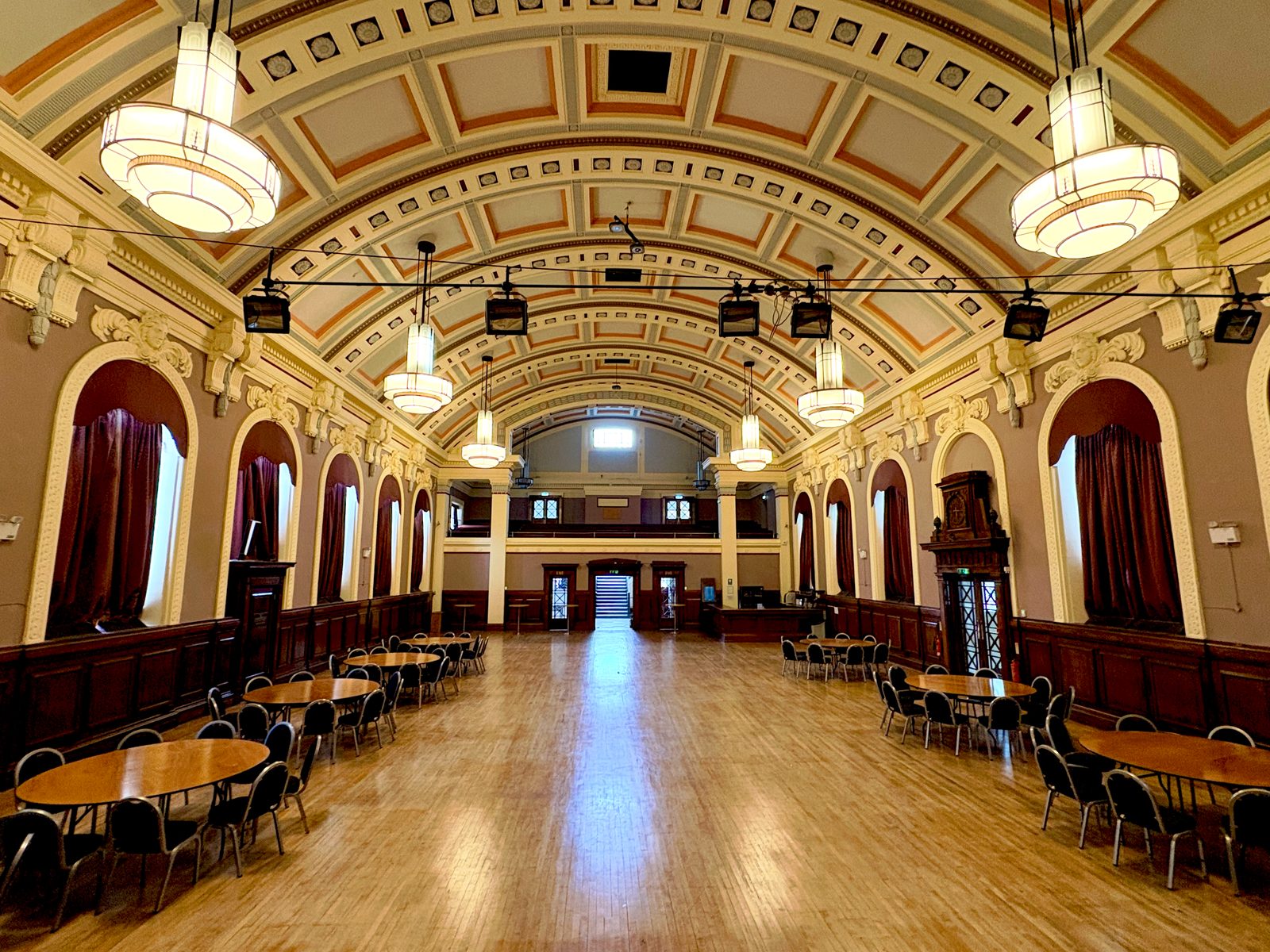
Wallasey Town Hall sits on Brighton Street in Seacombe, looking out over the Mersey. The foundation stone was laid by George V in 1914, the building served as a military hospital through the First World War, and it finally opened for civic use in November 1920. It is Grade II* listed, and the interior is a fair part of the reason why. Our route was not the ceremonial main staircase, the one that gets photographed, but the second stair hall that serves the Civic Hall. It is hardly a back stair. The floor at the foot of it is marble with a black inlaid border, and the balustrades are openwork cast iron by Walter Macfarlane and Co of Glasgow, which Historic England's listing picks out by name.
The piano was a Steinway Model A, a medium grand of a little over six feet, weighing a little over 315kg. This one is not a showroom instrument. The case is scuffed, the finish has softened, and it has clearly been played hard for a very long time, which is exactly what you want to see in a hall piano. It needed to go from the entrance level, up five flights, and onto the stage in the Civic Hall.

Two firms had already turned it down
One company arrived on site, looked at the staircase and said immediately that they could not do it. The second declined before turning up at all, on the grounds of the risk of damage.
We want to be fair about that. A firm that knows it is not equipped for a job and says so has done the right thing. It is a great deal better than starting a lift you cannot finish, halfway up a listed staircase, with a Steinway on the board. We said as much to the town hall staff on the day: if you are not confident, the sensible thing is to walk away. The problem is what the customer is left with, which is the impression that the move is impossible. Almost always, it is not. It just cannot be done by that crew, with the kit on that van, on that day.
There was a concert booked for 25 September
This was not a move that could simply wait for another quote. The council officer who booked us had a concert in the Civic Hall on 25 September, and with two attempts already behind her she was working out whether she needed to cancel it and start telling ticket holders. She was straight with us about it, told us she knew it was very late in the day, and asked whether there was any date at all that we could make work.
There was. We took the job on, it went in for 3 September, and the piano is on the stage where it needs to be. The concert goes ahead.
That is worth spelling out, because it is the part that gets missed when a piano move gets described as impossible. It is rarely just a piano sitting in the wrong place. There is usually a programme, a hire agreement, a hall full of people who have already bought tickets, and someone at the other end of it whose job it is to make all of that happen. The instrument is only ever the visible half of the problem.
Why a grand travels on its side
A grand piano does not go anywhere on its legs. The lid comes down and is secured, the pedal lyre comes off, the legs come off, and the instrument goes over onto its straight side on a padded piano board, where it is strapped and wrapped. On the flat it rides on skates. On stairs it is walked, one step at a time.
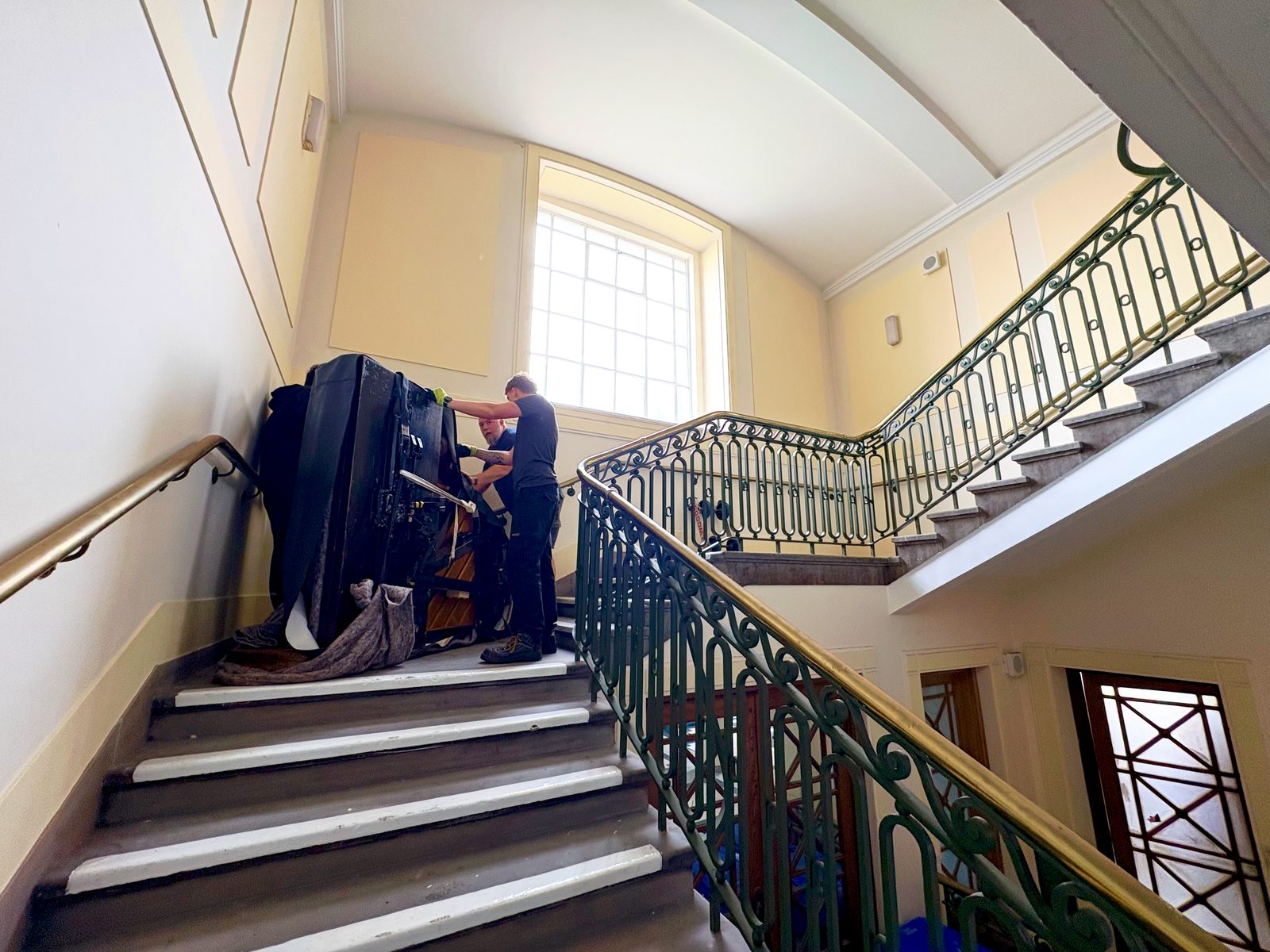
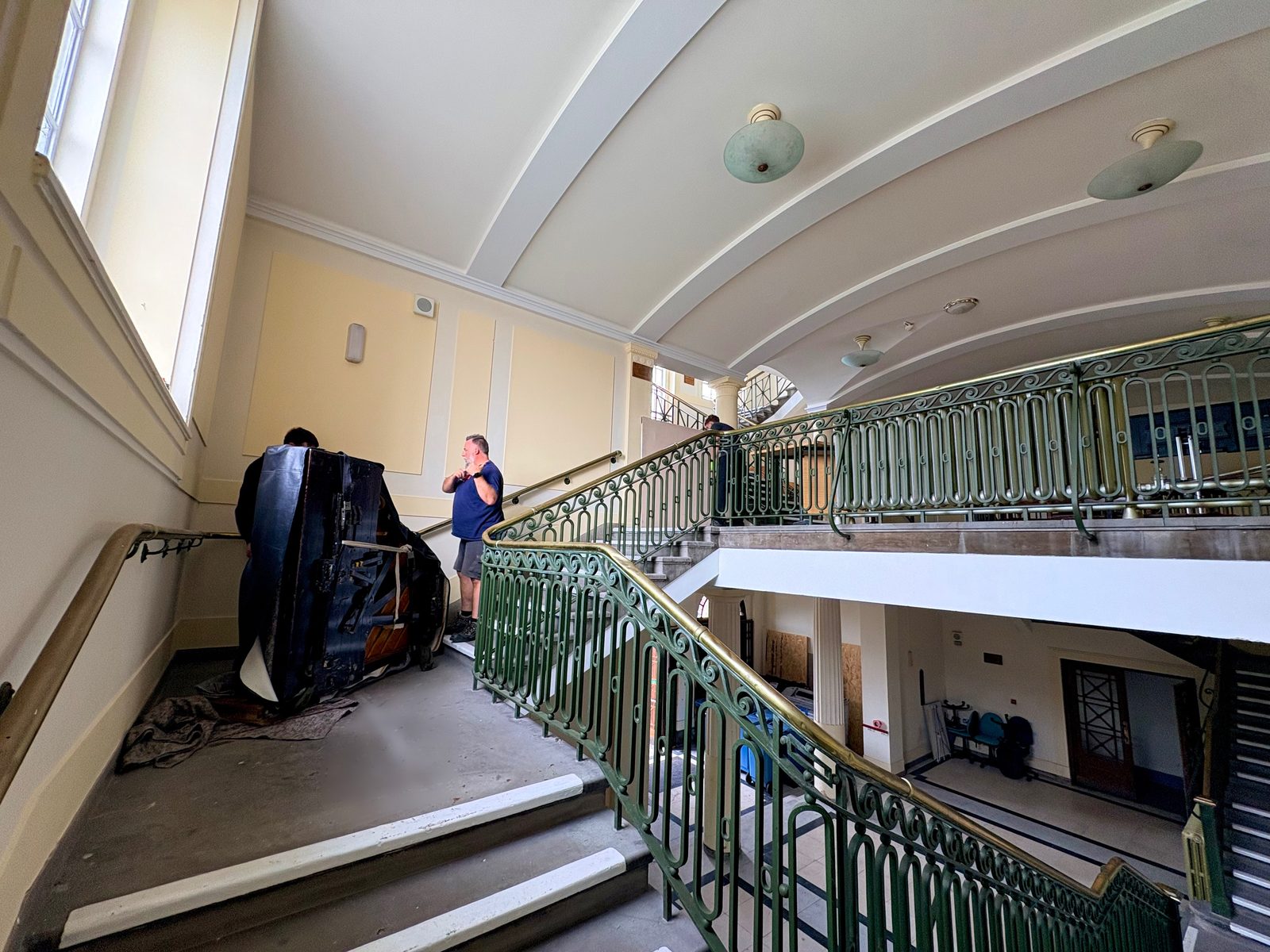
That sounds worse than it is, and it also sounds easier than it is. The weight is predictable and the board does the work, but the load has to stay under control at every single point of the climb. Nobody is carrying 315kg. We had four men on this one, two below taking the weight through the board and two above steering and holding position, and the piano moved one tread at a time, with a stop and a reset at every landing. Four is the right number for this job. Three would have made it a fight, and there is no room on that staircase for five.
Working inside a listed building
The second company was not wrong that there is risk here. There is. Cast iron of that age does not bend, it cracks, and there is marble underfoot at either end of the climb. The difference is whether you manage that or avoid it.
In a building like this, nothing is fixed to the fabric, nothing is wedged into the fabric of the building, and no part of the load ever goes through the balustrade. Ironwork of that age is decorative, not structural, and it is not there to lean a piano against. Treads and nosings get covered, the corners of every landing get protected, and the piano itself is covered before it leaves the ground floor. The turns are the tight part on a staircase like this one, not the straight runs, so the geometry of each corner gets worked out before the piano gets anywhere near it.
Back together on the stage
Once it is up, the job is only half done. The piano comes off the board and back onto its legs, the lyre goes back on, the pedals are checked, and it gets walked into position on the stage on skates before being lowered onto the floor.
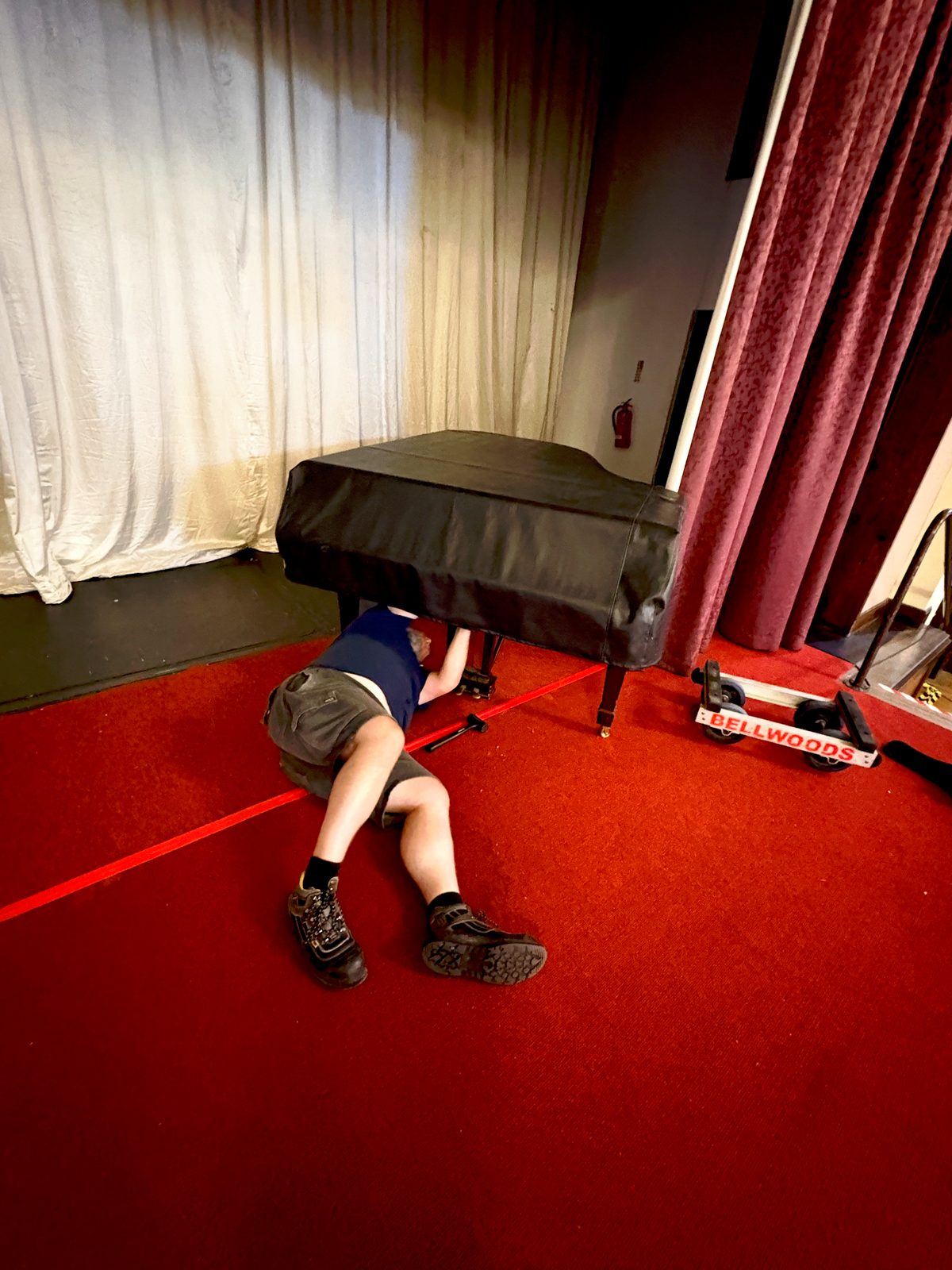
One thing worth saying to anyone who has just had a piano moved: leave it a few weeks before you have it tuned. An instrument needs time to settle to the temperature and humidity of its new room, and a tuning done the same day will not hold. That applies whether the piano has come up five flights or across a lounge.
Not all piano removers are equal
Plenty of removal firms will move a piano. Far fewer move pianos every week, and it is a different trade. The kit is different, the crew training is different, and the judgement about what will and will not go is built up over years of being wrong occasionally and remembering why.
We have been doing it since 1977, and the honest position is this: a job like Wallasey is not remarkable to us, it is a Tuesday. What made it a story is that the customer had already been told twice that it could not be done, and had a concert on the line while she waited to find out whether that was true.
What to ask before you book a piano move
If you have a difficult piano move coming up, in a hall, a church, a school or an ordinary house with an awkward staircase, these are the questions worth asking:
- Do you move pianos every week, or occasionally alongside house removals?
- What is on the van for this job? A piano board, skates, straps and proper covers should be a given.
- How many crew are coming, and have they worked this type of staircase before?
- What insurance covers the instrument in transit, and what covers the building?
- Will you look at the access first, either in person or on a video call, before quoting?
- Have you worked in listed or public buildings before?
A firm that is comfortable with the work will answer all six without hesitating. If you are being told a move is impossible, it is at least worth asking a specialist before you accept that.
Grand piano removals in Wallasey, Wirral and beyond
We are based in Huddersfield and we travel. Wallasey, the Wirral and Merseyside are well within our normal working range, and we cover the whole country for long-distance piano removals. Uprights, grands, baby grands, pianolas and organs, moved room to room, building to building or the length of the UK.
If you have a piano that other people have been reluctant to touch, send us a photo of it and the tight spot and we will tell you honestly whether it will go. You can read more about our piano removals service, or get a price straight away with our free piano removal quote. Family-run in Huddersfield since 1977.